Understand your requirement
Review part, product and process variation for robotic insert loading into moulds, arrival pattern and presentation, and required cycle and production pattern using your samples, drawings and production observations.
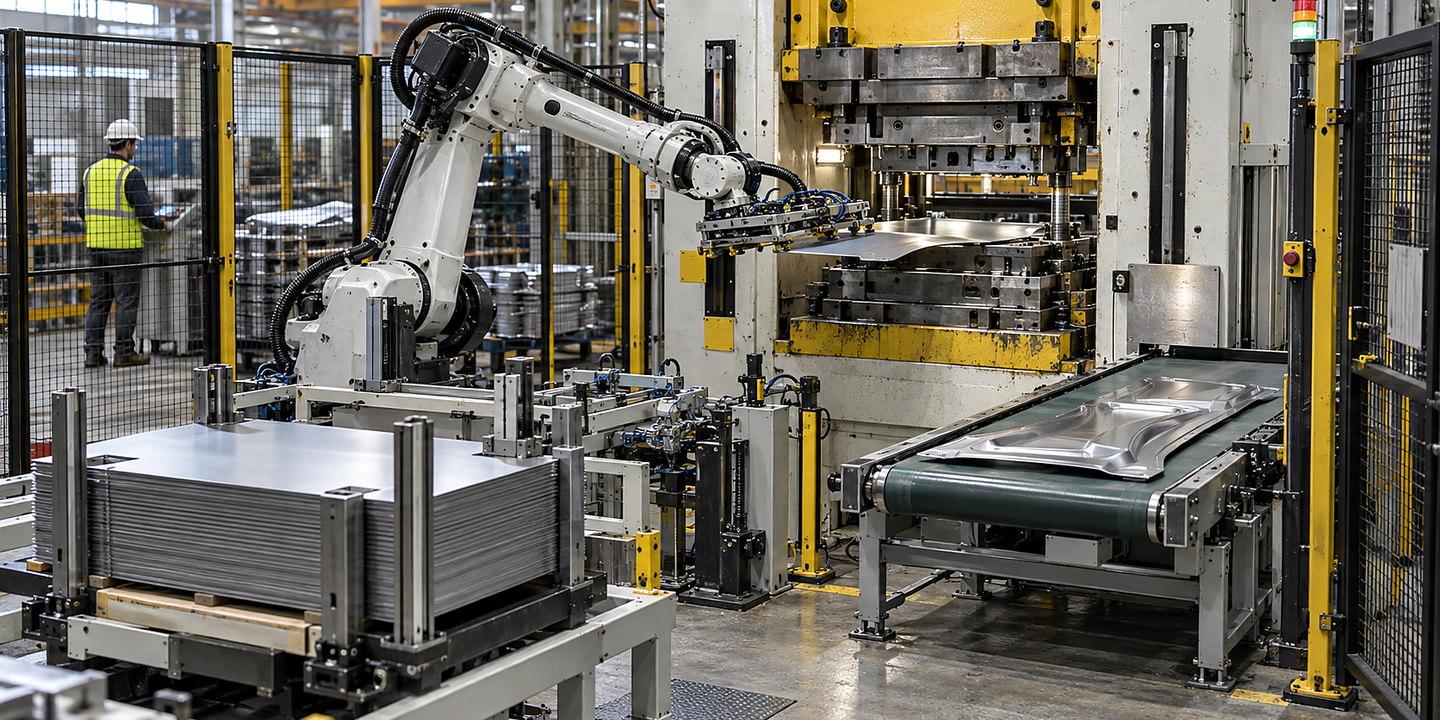
Compare practical options for robotic insert loading into moulds, including what each route needs, where it fits and what to check before you decide.
The right solution for robotic insert loading is the simplest system that reliably handles your stated duty, line connections and expected exceptions.
Plan robotic insert loading around your parts, process, cycle time, tooling, recovery and acceptance criteria. Discuss the highest-risk feasibility questions with Oxford Industrial Automation.
Plan robotic insert loading around your parts, process, cycle time, tooling, recovery and acceptance criteria. Discuss the highest-risk feasibility questions with Oxford Industrial Automation. When you compare solutions, check how each option handles part, product and process variation for robotic insert loading into moulds, arrival pattern and presentation and your surrounding line.
Discuss your application

Review part, product and process variation for robotic insert loading into moulds, arrival pattern and presentation, and required cycle and production pattern using your samples, drawings and production observations.
Run focused trials for robotic insert loading so you can see why an option is recommended or ruled out.
Resolve tooling, sensing and process interfaces, operator access, recovery and changeover, controls, safety, operator access and maintenance before site work.
Check run-off criteria and production evidence in normal, difficult and fault conditions, then agree training and support for your team.
Typical support: feasibility study, sample trials, cell design, offline build, integration and production ramp-up.
| Approach | Often suitable when | Watch for |
|---|---|---|
| Robotic Insert Loading | You need a dedicated solution for a clearly defined duty, product or part range and line interface. | Cycle time depends on the complete process rather than robot speed alone. |
| Purpose-Built Mechanical Automation for a Stable, Very High-Volume Task | Your volumes, product mix or operator judgement make a simpler route more practical. | Check ergonomics, consistency and safe access before choosing the lower-complexity option. |
| Operator-Assisted Fixtures where Flexibility or Business Case Does Not Support a Robot Cell | Your surrounding process is stable enough for a broader automated solution to add value. | Allow for line connections, fault recovery and maintenance as well as the headline equipment. |